Blog
Why Lifestyle Modification, Not Motivation, Is the Key to Long-Term Health?
By Dr Cibi John Francis Ph.D (www.drjohnfrancis.com)

By Dr Cibi John Francis
(www.drjohnfrancis.com)
People applaud motivation. Motivational quotes fill our feeds, and short bursts of enthusiasm often spark a new diet, a week of training, or a “fresh start” Monday. But motivation is a moment. Long-term health—lasting vitality, stress resilience, and graceful aging - comes from something quieter and more reliable: lifestyle modification.
Lifestyle modification means designing daily rhythms, habits, and environments so healthy choices happen automatically. When you pair that modern behavioural insight with the millennia-old wisdom of Yoga and martial arts, you get a practical, scientifically supported blueprint for a life that sustains itself. Shinsei Taiso Do is one such synthesis: an approach that uses slow, mindful movement, breath, and ritual to convert fleeting motivation into embodied habit.
Motivation is the spark; habit is the architecture
Motivation can start a habit; it rarely finishes one. Psychological research shows that habits form when behaviours are repeated in stable contexts until cues produce automatic responses - so the environment and routine matter far more than episodic inspiration. Foundational habit research demonstrates that forming a new automatic behaviour typically takes weeks to months and depends on context, consistency, and simplicity rather than willpower alone.
Wendy Wood and colleagues further stress that habits are triggered by cues in our environment and often operate independently of goals; once formed, they run with little conscious effort. This is why changing your morning context (where you sleep, what you see first, what’s next to your bed) is more powerful than pep talks.
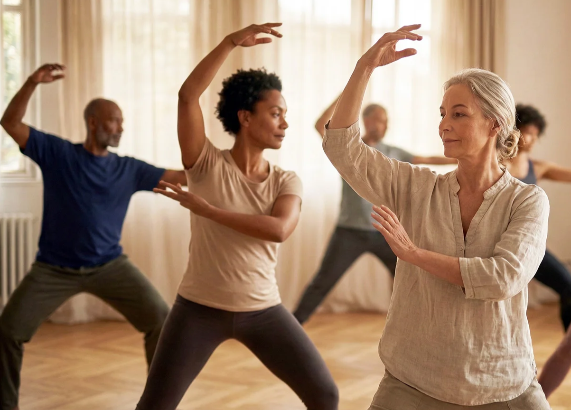
Shinsei Taiso Do takes advantage of this: short, repeatable movement rituals - practiced at a fixed time and place, and linked to breath and posture - become contextual cues. Over time, these rituals morph into habit: calm breath, better alignment, and nervous-system balance become the default, not the exception.
Why small, daily practices beat heroic effort
Clinical evidence shows that structured lifestyle interventions produce large, durable health gains. The Diabetes Prevention Program (DPP) famously reduced the incidence of type 2 diabetes by 58% using achievable lifestyle changes (weight loss, diet, and regular physical activity), outperforming metformin. That success came from consistent small behaviours, not from sustained high motivation.
Likewise, mind–body practices like Yoga and Tai Chi deliver measurable benefits for stress regulation and autonomic balance - outcomes that support long-term health when practiced regularly. Meta-analytic work shows mind–body exercise improves heart-rate variability (a marker of parasympathetic tone and stress resilience) and lowers perceived stress. These are the physiological foundations of sustainable well-being.
Thus, the lesson is simple: design slow, repeatable practices that the nervous system can learn - rather than rely only on high-energy training sessions that require constant motivational fuel.
Eastern philosophy: ritual, attention, and gradual transformation
Eastern systems treat health as a way of life. Yoga’s “yoking” (yuj) binds breath, posture, and mind; martial arts emphasize mastery through disciplined repetition of fundamentals long before flashy technique. Both traditions assume development is incremental: mastery arises from attention to small details and from ritualized practice in a stable context.
Shinsei Taiso Do translates that ethos into modern life. Its slow-tempo drills, breath rituals, and alignment-based progressions are not mere exercises; they are lifestyle scaffolds - daily actions that reshape nervous-system set points, posture, and emotional reactivity over months and years. The Eastern view reframes exercise from a task to complete into a mode of living to inhabit.
Physiology: why the body prefers regulation over extremes
‘Sustained sympathetic arousal’ (the “go fast” stress response) contributes to disrupted sleep, inflammation, and metabolic wear-and-tear. Mindful, breath-linked movement promotes parasympathetic activation - improving heart-rate variability and lowering cortisol reactivity - which is protective against chronic disease. Meta-analyses of mindfulness and mind–body programs have reported beneficial effects on cortisol and autonomic markers, especially when interventions are regular and of sufficient dose.
Shinsei Taiso Do’s slow, breath-coordinated approach deliberately trains the nervous system to switch into recovery mode daily, reducing cumulative stress load and supporting long-term repair. Over years, small neuroendocrine advantages compound into reduced disease risk and better mood regulation.
Practical framework: how to convert motivation into lifestyle
- Fix a context — choose a regular time and place for your Shinsei Taiso Do ritual (morning light, after a shower, or before dinner). Contextual stability makes habits automatic.
- Start tiny — choose 8–12 minutes of slow movement and breath. Small, consistent practice outperforms sporadic high effort.
- Anchor with breath — begin with short diaphragmatic breath cycles; breath links mind and body and primes parasympathetic tone.
- Scale by ritual, not willpower — add small progressions (range, balance, subtle resistance) once the base routine becomes automatic.
- Design your environment — place a mat, a reminder, or a visible cue so your context prompts practice; change contexts to break old, unhealthy habits.
Motivation lights the fire. Lifestyle - the intentionally designed set of daily cues, rituals, and contexts - keeps it burning. The combined wisdom of Shinsei Taiso Do, Yoga science, and martial arts reminds us that fitness is woven into life, not scheduled on top of it. Modern behaviour science and physiology back this up: consistent small changes and environmental design produce deep, durable health benefits.
If you want lasting health in 2026 and beyond, stop depending on motivation. Build your life so health becomes the easiest choice—and let Shinsei Taiso Do be the gentle architecture that supports that choice every day.
Selected references (APA style)
- Knowler, W. C., Barrett-Connor, E., Fowler, S. E., et al. (2002). Reduction in the incidence of type 2 diabetes with lifestyle intervention or metformin. New England Journal of Medicine, 346(6), 393–403.
- Zou, L., Sasaki, J., Wei, G. X., et al. (2018). Effects of mind–body exercises (Tai Chi/Yoga) on heart rate variability and stress: A systematic review and meta-analysis. Journal of Clinical Medicine, 7(6), 164.
- Sanada, K., Montero-Marín, J., Alda Diez, M., et al. (2016). Effects of mindfulness-based interventions on salivary cortisol: A meta-analytic review. Psychoneuroendocrinology, 63, 77–86.
- Lally, P., van Jaarsveld, C. H. M., Potts, H. W. W., & Wardle, J. (2010). How are habits formed: Modelling habit formation in the real world. European Journal of Social Psychology, 40(6), 998–1009.
Related Blog
-
Why Slow Movement is the Future of Fitness and Stress Relief?
By Dr Cibi John Francis(www.drjohnfrancis.com)Shinsei Taiso Do, Yoga Science, and Martial Arts Wisdom in the 21st CenturyWe live in a world that pri...
-
Mindful Fitness vs High-Intensity Training: Which Is Better for Long-Term Health?
‘A Science-Informed Dialogue Between Modern Exercise and Eastern Movement Wisdom’By Dr Cibi John Francis Ph.D In the modern fitness world, high-i...