Blog
Mindful Fitness vs High-Intensity Training: Which Is Better for Long-Term Health?
By Dr Cibi John Francis Ph.D (www.drjohnfrancis.com)

‘A Science-Informed Dialogue Between Modern Exercise and Eastern Movement Wisdom’
By Dr Cibi John Francis Ph.D
In the modern fitness world, high-intensity training dominates headlines. Faster workouts, higher heart rates, and maximum exertion are often marketed as the fastest path to health. Yet alongside this rise, we see increasing rates of burnout, chronic pain, anxiety, overtraining injuries, and stress-related illness. This paradox invites a deeper question: Is intensity truly the best path to long-term health?
Eastern movement traditions - refined today through systems like Shinsei Taiso Do, Yoga science, and classical martial arts—offer an alternative paradigm: mindful fitness. Rooted in slowness, breath, and internal regulation, these systems aim not merely to strengthen the body, but to stabilize the nervous system and cultivate lifelong resilience.
Modern science is now revealing that these ancient insights may be more relevant than ever.
Two paradigms of fitness: output vs regulation
High-intensity training (HIT) emphasizes short bursts of maximal effort, often elevating heart rate close to maximum capacity. It can improve cardiovascular fitness and metabolic markers in the short term, especially in younger, healthy populations.
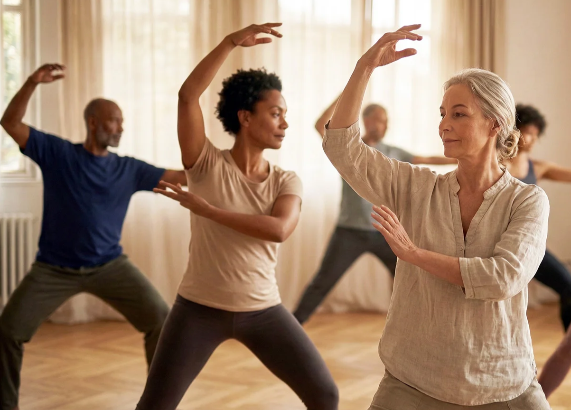
Mindful fitness, by contrast, focuses on movement quality, breath coordination, and nervous-system awareness. In Shinsei Taiso Do, slow martial-inspired exercises train posture, balance, and internal stability before speed or load. Yoga science similarly prioritizes breath-led movement, while martial arts traditionally demand slow foundational practice before explosive techniques.
The difference between these approaches is not philosophical alone - it is physiological.
The nervous system: the missing factor in long-term health
Here is one fact: From a biological perspective, exercise is a stressor. The question is whether that stress is adaptive or cumulative.
According to various studies, high-intensity training predominantly activates the sympathetic nervous system (fight-or-flight). While beneficial in controlled doses, repeated sympathetic dominance - especially without adequate recovery - can elevate cortisol, disrupt sleep, impair immune function, and increase injury risk.
Mindful fitness, as practiced in Yoga, and Shinsei Taiso Do, activates the parasympathetic nervous system, improving vagal tone and heart-rate variability (HRV). Meta-analyses of mind–body practices consistently show improvements in HRV and reductions in perceived stress, indicating enhanced autonomic balance and resilience.
This autonomic flexibility is a strong predictor of long-term cardiovascular health, emotional regulation, and longevity.
Hormonal health and stress resilience
Chronic elevation of stress hormones is now recognized as a key contributor to metabolic disease, depression, and accelerated aging. While high-intensity training can temporarily increase cortisol, mindful movement practices tend to normalize cortisol rhythms.
A large meta-analysis examining mindfulness-based and mind–body interventions found significant reductions in cortisol levels and stress reactivity across diverse populations. These effects were most consistent when movement was slow, breath-regulated, and practiced regularly rather than sporadically.
Shinsei Taiso Do leverages this principle by pairing slow martial movement with conscious breathing - training the body to remain calm under physical load, a core skill traditionally cultivated in Eastern martial systems.
Musculoskeletal health: strength without breakdown
High-intensity training can build muscle and power, but it also carries a higher risk of joint degeneration and overuse injuries over time, particularly in aging populations.
Mindful fitness emphasizes tendon integrity, joint alignment, and proprioception. Research on Tai Chi originally a martial art - shows improvements in balance, functional strength, and fall prevention, especially in older adults. These benefits directly support long-term mobility and independence.
Yoga-based movement similarly improves flexibility, muscular endurance, and postural stability without excessive joint stress. Shinsei Taiso Do integrates these principles into slow, progressive movement patterns designed to support longevity rather than peak performance alone.
Neuroplasticity and mental health benefits
Modern neuroscience confirms that exercise influences brain structure and function. However, how we move matters.
Mindful movement enhances neuroplasticity by combining physical action with sustained attention and sensory feedback. Reviews of exercise and brain health suggest that attention-rich, low-impact movement improves cognitive flexibility, emotional regulation, and stress processing - especially in populations experiencing anxiety, burnout, or neurological vulnerability.
In Eastern martial arts, slow movement is used to sharpen awareness and cultivate calm presence. Shinsei Taiso Do continues this tradition, using movement as a tool for psychological stability, not just physical conditioning.
Sustainability: the ultimate measure of fitness
Perhaps the most important question for long-term health is not “What works fastest?” but “What can be sustained for decades?”
Studies consistently show that adherence is higher for low-impact, enjoyable movement practices than for high-intensity regimens. Mindful fitness encourages regular practice without fear of injury or exhaustion, making it accessible across age groups and health conditions.
Eastern systems never separated fitness from daily life. Movement was a lifelong discipline - adaptive, restorative, and self-regulating. Shinsei Taiso Do embodies this philosophy by offering a modern framework for sustainable, nervous-system-informed fitness.
Conclusion: integration, not opposition
High-intensity training is not inherently harmful. When used strategically and sparingly, it can enhance physical capacity. However, for long-term health, mindful fitness provides the foundation.
Shinsei Taiso Do, Yoga science, and martial arts traditions teach that strength without awareness leads to imbalance, while awareness cultivated through slow movement leads to enduring vitality.
As modern science increasingly validates Eastern wisdom, the future of fitness is becoming clear: Move intelligently. Breathe consciously. Train the nervous system - not just the muscles. Mindful fitness is not a softer option - it is a wiser one.
Bibliographical References:
- Zou, L., Sasaki, J. E., Wei, G. X., et al. (2018). Effects of mind–body exercises on heart rate variability: A systematic review and meta-analysis. Journal of Clinical Medicine, 7(6), 164.
- Sanada, K., Montero-Marin, J., Diez, M. A., et al. (2016). Effects of mindfulness-based interventions on salivary cortisol: A meta-analytic review. Psychoneuroendocrinology, 63, 77–86.
- Huston, P., & McFarlane, B. (2016). Health benefits of Tai Chi: What is the evidence? Canadian Family Physician, 62(11), 881–890.
- Erickson, K. I., Hillman, C., & Kramer, A. F. (2015). Physical activity, brain, and cognition. Current Opinion in Behavioral Sciences, 4, 27–32.
By Dr Cibi John Francis
(www.drjohnfrancis.com)
Related Blog
-
Why Slow Movement is the Future of Fitness and Stress Relief?
By Dr Cibi John Francis(www.drjohnfrancis.com)Shinsei Taiso Do, Yoga Science, and Martial Arts Wisdom in the 21st CenturyWe live in a world that pri...
-
Why Lifestyle Modification, Not Motivation, Is the Key to Long-Term Health?
By Dr Cibi John Francis(www.drjohnfrancis.com)People applaud motivation. Motivational quotes fill our feeds, and short bursts of enthusiasm often spar...